
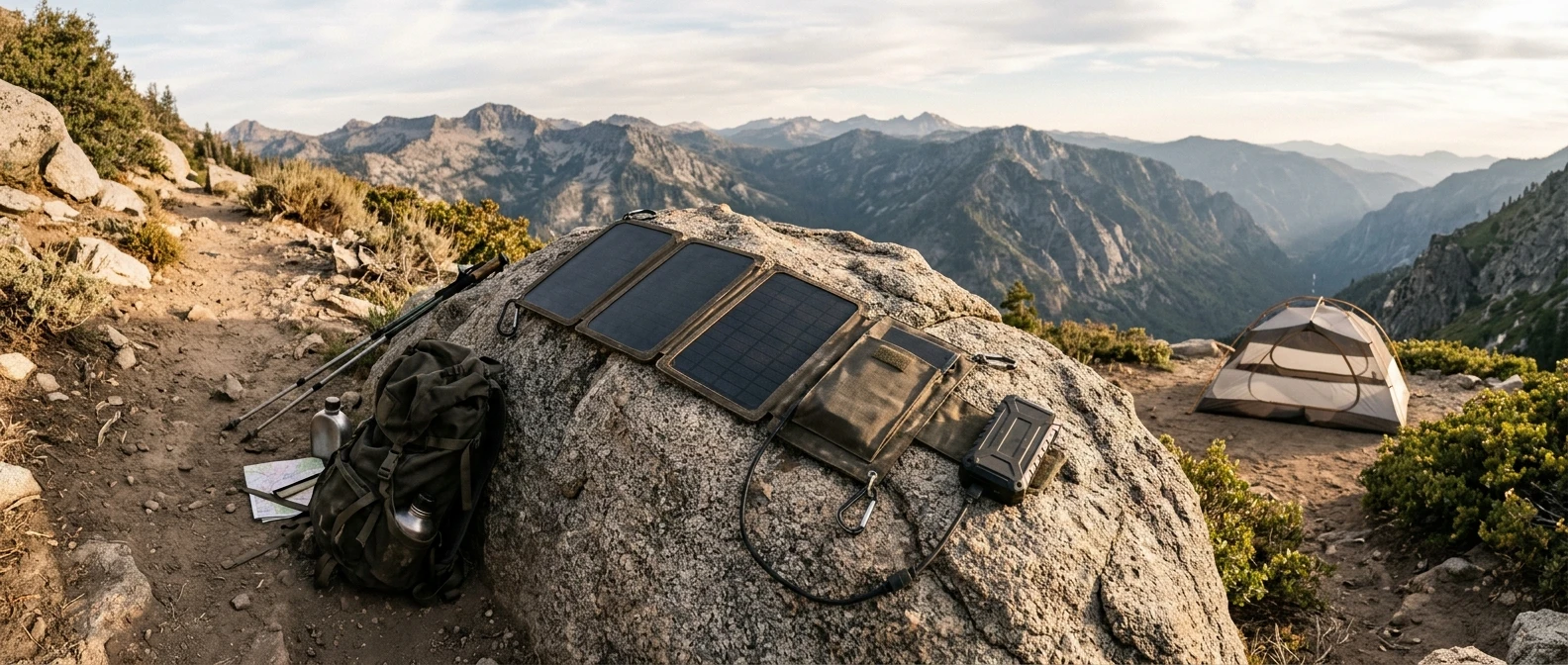
When a solar charger earns its place in your bag (and when it doesn’t)
A solar charger is worth carrying when you will go long enough without an outlet that a power bank alone will run out, and when you will spend daylight hours somewhere the panel can sit in open sun. That describes a week on a trail with long exposed ridgelines, an overland route across open country, or a camp where the vehicle is parked for days. In those cases a panel adds energy that you could not carry in a battery.
It does not earn its place on a weekend trip with modest needs. A phone, a GPS unit and a small camera can usually get through two or three days on a single well-sized power bank, and the panel adds weight, strapping fuss and a dependence on weather. If your days are spent under forest canopy or in a valley with a few hours of direct sun, the panel will often sit in your pack doing nothing.
The honest test is simple: add up the energy your devices need for the whole trip, compare it with what you can carry in batteries, and consider solar only for the gap.
Panel or solar power bank: the two types and how each behaves in the field
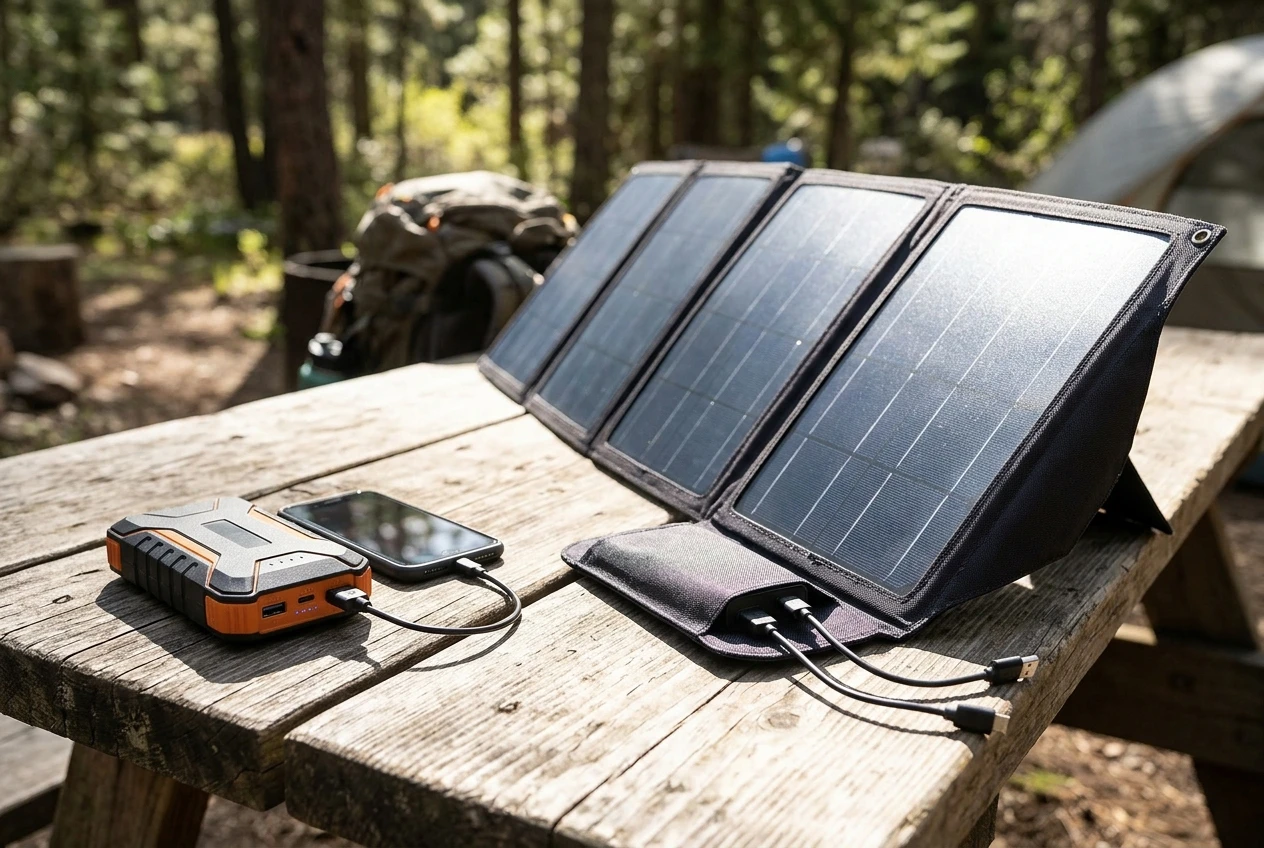
A folding panel is a set of solar cells on fabric or laminated sheets, with a USB port or two. It has no storage of its own, so output depends entirely on the light hitting it. Because the panel is separate from the battery, you can strap it to a pack, lay it on a tent, or tilt it toward the sun while the battery stays in the shade, which keeps the battery cooler.
A solar power bank is a battery with a small panel built into its casing. It looks convenient, but the panel is tiny, so it gathers energy very slowly. Treat it as a top-up that might add a little charge over several days of sitting on a dashboard or tent roof. It is not a way to recharge a drained battery in an afternoon.
For serious off-grid use, the separate panel plus a separate battery is the more capable setup. The built-in panel on a power bank is a bonus feature, and a bank’s real value is its battery capacity, ports and build quality.
What to expect from real sun: cloud, angle, heat and why the label wattage is a best case
The wattage printed on a panel is measured under ideal laboratory conditions: strong direct sun, the panel facing it squarely and the cells at a moderate temperature. Out on a trail you will rarely get all three at once, so actual output is usually well below the label.
Several things reduce it:
- Cloud and haze. Thin cloud cuts output noticeably, and heavy overcast can reduce it to a trickle.
- Angle. A panel produces the most when it faces the sun directly. Lying flat on the ground at low sun angles, early or late in the day, wastes much of the light. Tilt it toward the sun and adjust every hour or so.
- Partial shade. Even a shadow from a strap, a pack or a branch across part of the panel can cut output sharply, because the cells are wired together.
- Heat. Silicon cells lose efficiency as they get hot, so a panel baking on a dark rock is less productive than the sunshine suggests.
- Conversion losses. Charging a battery through cables and circuits wastes some energy as heat.
As a rough illustration, a 10 W panel that delivers half its rating for four hours gives about 20 Wh of energy before losses. Many phone batteries hold somewhere around 11 to 19 Wh, so that is the order of one phone charge, not several. Check your own device’s battery capacity and do this sum before you decide.
Matching your kit to trip length: a weekend, a week, and beyond
A weekend (two to three days). Carry a power bank sized to your devices and skip the panel. Charge everything fully before you leave, switch phones to low power or airplane mode, and keep the GPS screen off when you can.
A week. This is where a panel starts to make sense, depending on terrain and climate. If you will be in open, sunny country, a panel of moderate size paired with a battery can cover the gap that the battery alone leaves. If the route is forested or the forecast is mixed, consider a larger battery instead, or a second one.
Beyond a week. Resupply is unlikely, so a panel becomes part of the plan, along with careful energy budgeting. Add up daily use for each device, then work out how many sunny hours you need to cover it. Carry spare cables and plan which devices are essential. Many overland travelers with a vehicle can also charge from the vehicle’s outlet while driving, which is far more reliable than a panel and worth using whenever you have it.
Pairing a panel with a battery so you can charge when the sun isn’t out
Panels produce power only while the sun is up, and you often want to charge your phone at night or while you are walking. The solution is to let the panel fill a power bank during the day, then charge devices from the bank whenever you like.
Many panels deliver a variable current that changes as clouds pass, and some phones stop and start charging when the supply fluctuates. Charging a power bank is usually more forgiving, because the bank’s circuitry manages the input. Look for a bank that accepts charging while it is also discharging, often called pass-through, and check its manual before relying on that feature.
Battery capacity also sets how much of the panel’s work you can store. A panel can produce more than a small bank can hold on a sunny day, so match the two. Our guide to choosing a portable charger covers capacity and ports in more detail.
How to set up and use it on the move
Strap the panel to the outside of your pack, on the top or the back panel, so it faces the sun while you walk. This gives the panel hours of light without any stopping. Expect less output than a stationary panel at a perfect angle, because your body and the pack move and the angle keeps changing, but it adds up over a long day.
At camp, set the panel in direct sun, propped at an angle toward the sun, and weigh it down so wind cannot flip it. Run the cable to the battery in the shade, such as inside the tent vestibule or a pack. Hot batteries charge less efficiently and can shut down.
Some habits make the setup more reliable:
- Charge the battery from the panel, then charge devices from the battery.
- Check that a charge is actually happening shortly after connecting, because a loose cable or shaded cell can mean nothing is flowing.
- Keep cables short and coiled, and carry a spare.
- Put phones in airplane mode while they charge, which speeds the process.
- Clean the panel surface of dust or dirt, which reduces output.
Gear to check before you buy
Specifications matter more than brand names. Before buying, check these points:
- Ports. USB-A is common, and USB-C is increasingly standard. Confirm the port types match your cables and that the panel can charge a battery with the input type you own.
- Output rating and what it means. The total rated wattage is a best-case figure. If the panel lists separate outputs for each port, check how that power splits when both are in use.
- Weatherproofing. Look for stated water or splash resistance, and check whether it covers the panel, the cable junction and the controller or ports. Rain and dust are routine on trips like these.
- Weight and folded size. The panel must fit your pack and be light enough that you will actually carry it. A panel left at home produces nothing.
- Attachment points. Loops, grommets or clips make strapping to a pack or tent far easier.
- Build quality. Stitching, hinge points and the cable strain relief are common failure points on folding panels.
If you also carry a camera, check its charging method. Some cameras charge by USB directly, while others need a separate charger for their battery, which changes what you need to carry. Our piece on action cameras built for extreme conditions is a useful reference for that gear.
Common mistakes that leave people with a dead phone anyway
Trusting the label. Planning around the rated wattage leads to a shortfall. Plan on a fraction of it and treat anything better as a bonus.
Charging the phone directly from the panel. When clouds pass, the phone may stop charging and not resume. Charging through a battery avoids this.
Leaving the panel in a pack. If the panel is not exposed to sunlight, it produces nothing. A panel that needs a deliberate setup tends to get skipped when you are tired, so strapping it outside the pack is the better habit.
Letting devices drain needlessly. Screen brightness, constant GPS tracking, poor signal searching and background apps use far more energy than most people expect. Reducing use is cheaper than generating more power.
Skipping a test. Try the panel and battery together at home before the trip. Confirm the cables fit, the battery accepts the input and the devices charge. Discovering a mismatch at a trailhead is much worse.
Ignoring cold. Batteries lose usable capacity in low temperatures, so keep them in an inner pocket or sleeping bag overnight.
If you are still deciding which battery to pair with your panel, read our guide on how to choose the best portable charger for your trips.